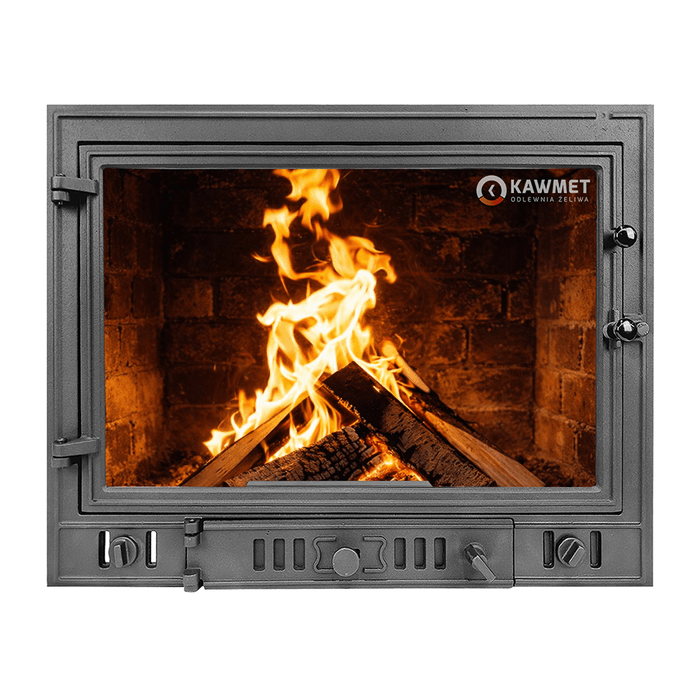
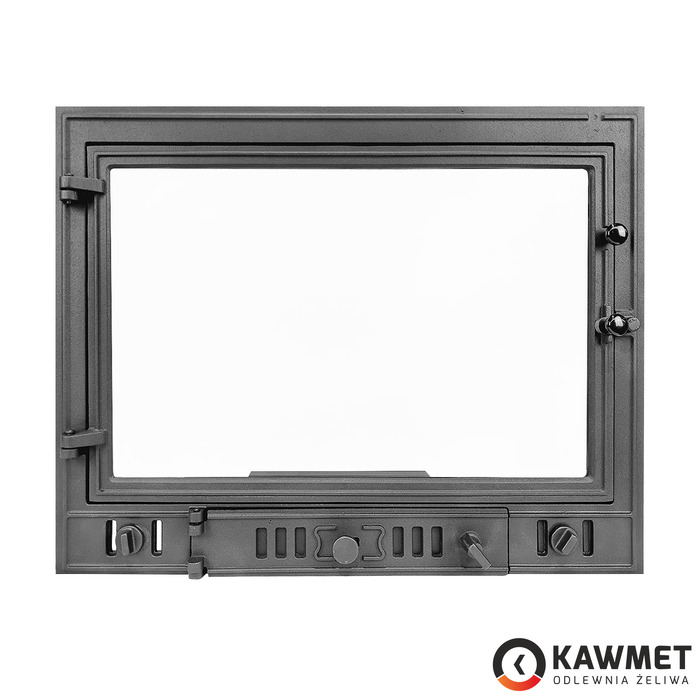
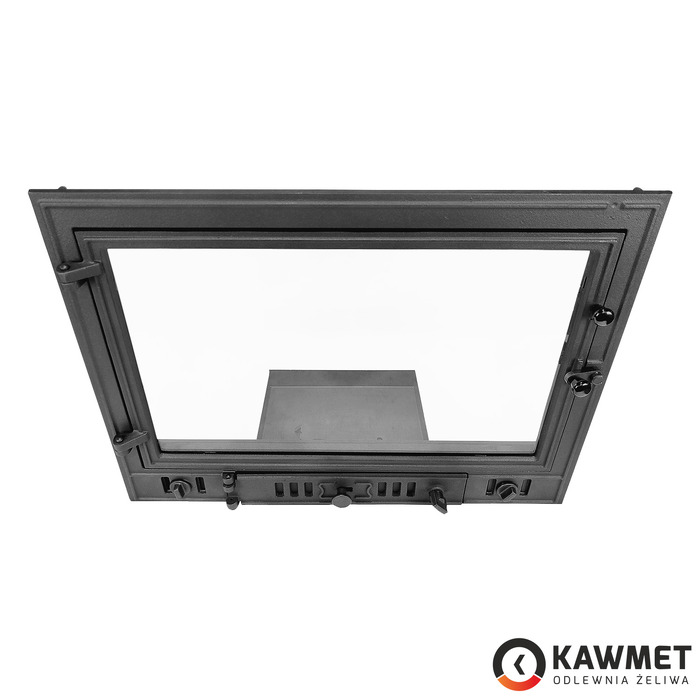
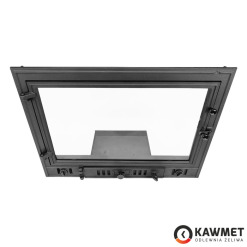
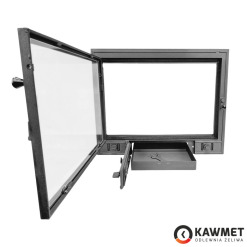
KAWMET W3-W4 (700x540) Fireplace Door
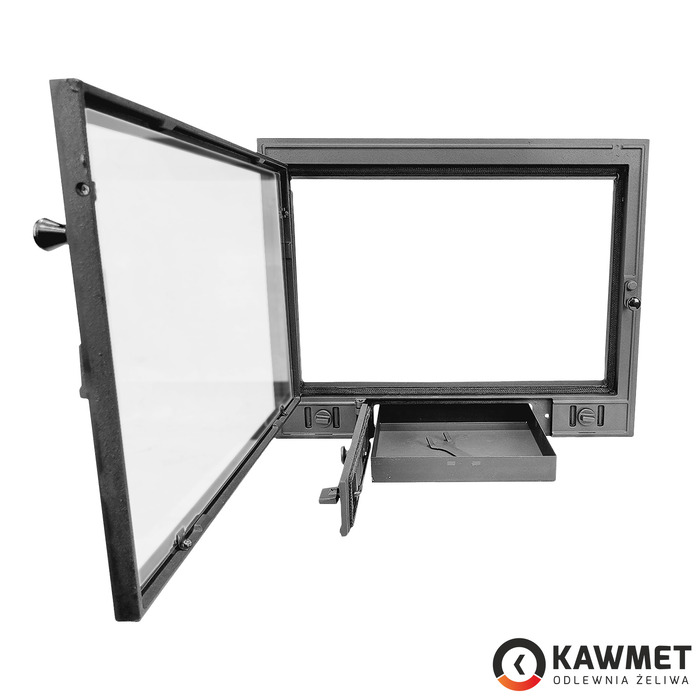
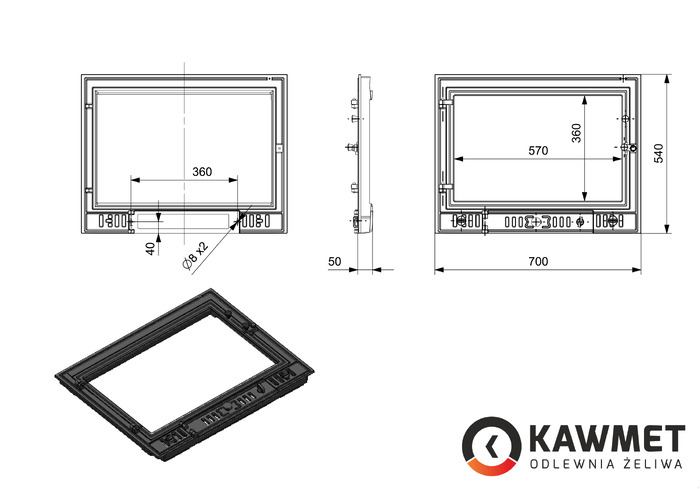
KAWMET W3-W4 (700x540) is a complete cast iron fireplace door measuring 700 × 540 mm overall, intended for the KAWMET W3 and KAWMET W4 fireplace inserts. The set includes the door, frame, glass and ash pan — a ready-made firebox front, not a bare leaf casting.
The material is grey cast iron, grade 200. In a fireplace door what matters is not impact strength but resistance to the cycle: heating to several hundred degrees and cooling down, repeated hundreds of times a season. Cast iron takes this without the warping that stops sheet-metal doors from closing tightly. The pane is Schott ROBAX® ceramic glass rated to 760 °C. The set weighs 28 kg.
Key features — W3-W4
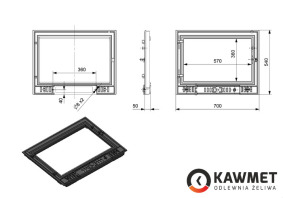
- Overall dimensions 700 × 540 mm (W × H)
- Main pane 570 × 360 mm — approx. 2050 cm² of visible fire
- Glass: heat-resistant Schott ROBAX® ceramic rated to 760 °C
- Material: grey cast iron, grade 200
- Set weight 28 kg
- Set contents: door, frame, glass, ash pan and a handle set (door handle and ash pan handle)
- Fit the KAWMET W3 and KAWMET W4 fireplace inserts
- Also used for closing open fireplaces, in tiled stoves and in masonry grills
- Manufacturer: KAWMET, Poland
Which insert these doors fit
The manufacturer assigns this set to the KAWMET W3 and KAWMET W4 fireplace inserts. The overall dimensions of 700 × 540 mm match the opening of those models — a door from a different KAWMET insert will not fit, as every series has its own frame outline.
If you are buying the door not as a replacement but for a masonry firebox, what decides is the size of the opening in the surround. Measure it before ordering and compare it with the overall dimensions above — picking by insert name alone does not work here.
Why a closed firebox heats more economically
In an open fireplace most of the heat escapes up the chimney with the flue gases, and combustion air is drawn from the room with no control at all. A glazed door changes both. The pane reflects up to 35 % of the thermal radiation back into the combustion chamber, raising the temperature in the firebox — which is the condition for the wood gases to burn off rather than escape up the flue unburnt.
The result is higher efficiency and lower wood consumption for the same heating effect. On top of that comes control: throttling the air supply sets the intensity of the fire and holds the required temperature — something an open firebox cannot do. And the basic point: a closed firebox does not let smoke or sparks into the room.
Installation — a 28 kg set
The set weighs 28 kg, which means fitting it with a second person or propping the frame while it is aligned. That mass is an advantage in use, though: the inertia of the cast iron damps the shock of closing, and once hot the casting keeps radiating heat well after the fire has died — the door then acts as another heating surface rather than just a barrier.
What the set includes
The set contains the door, frame, glass and ash pan, plus a handle set: the door handle and the ash pan handle. It is a complete assembly ready to be fitted — not a bare leaf casting for which the frame and glass have to be bought separately.
Where else these doors can be fitted
Beyond replacing the door in an existing insert, the manufacturer lists three other uses:
- Closing an open fireplace — converting an open firebox into a closed one, the most common reason for buying a separate door.
- New fireplaces — the door as a ready-made front for a firebox built from scratch.
- Tiled stoves — replacing or completing the front of a masonry heater.
- Masonry grills — enclosing the firebox of a garden grill.
In each of these cases what decides success is the size of the opening in the surround, not the insert model — measure it before ordering.
How do I check whether the door fits my fireplace?
Measure the firebox opening — clear width and height — and compare it with the door's overall dimensions: 700 × 540 mm. The frame needs something to rest on, so the opening must not be larger than the outline of the door. Replacing the door in a finished insert is simpler: the set is assigned to the KAWMET W3 and KAWMET W4 models and fits without modification.
How does ceramic glass differ from ordinary heat-resistant glass?
The Schott ROBAX® ceramic used here withstands 760 °C and — more importantly — tolerates the sharp temperature difference between the hot centre and the cool edge at the frame. Ordinary toughened glass cracks under those conditions. Ceramic also does not lose transparency with use: a pane that looks permanently hazed is usually just fouled with soot from damp wood.
Can these doors close an open fireplace?
Yes — the manufacturer lists this as one of the main applications, alongside new fireplaces, tiled stoves and masonry grills. Closing an open firebox is in fact the case with the biggest gain: an open fireplace delivers only a small share of the wood's energy to the room and sends the rest up the chimney. The conditions are a matching opening size and a sound, correctly sized flue — worth consulting a chimney sweep before converting.
How should the cast iron door and the glass be cared for?
Clean the glass cold, with a fireplace glass cleaner or a damp cloth and a little wood ash — ash is a mild abrasive and handles the deposit better than most detergents. Do not scrub the cast iron wet: sweep the ash away and wipe with a dry cloth. If the glass fouls quickly, the cause is usually wood that is too damp or burning with the air supply throttled far down, not the glass itself.
KAWMET fireplace doors are cast in Poland, at the works in Zadąbrowie. Your nearest representative will confirm availability and purchase terms.