
Cast iron or steel fireplace insert? Both can heat well, and you will find both among appliances that meet the EU Ecodesign requirements. The body material on its own rarely decides whether a fireplace turns out to be a good buy. What matters more is output matched to the heat demand of the house, the weight of the appliance, the size of the glass, the dimensions of the surround and the requirements of the installation manual. Only then does the material affect how the insert heats up, how you use it and what its typical weak points are.
Below we explain how the two types of insert really differ, which popular opinions are oversimplified and how to compare specific models on the basis of their documentation.
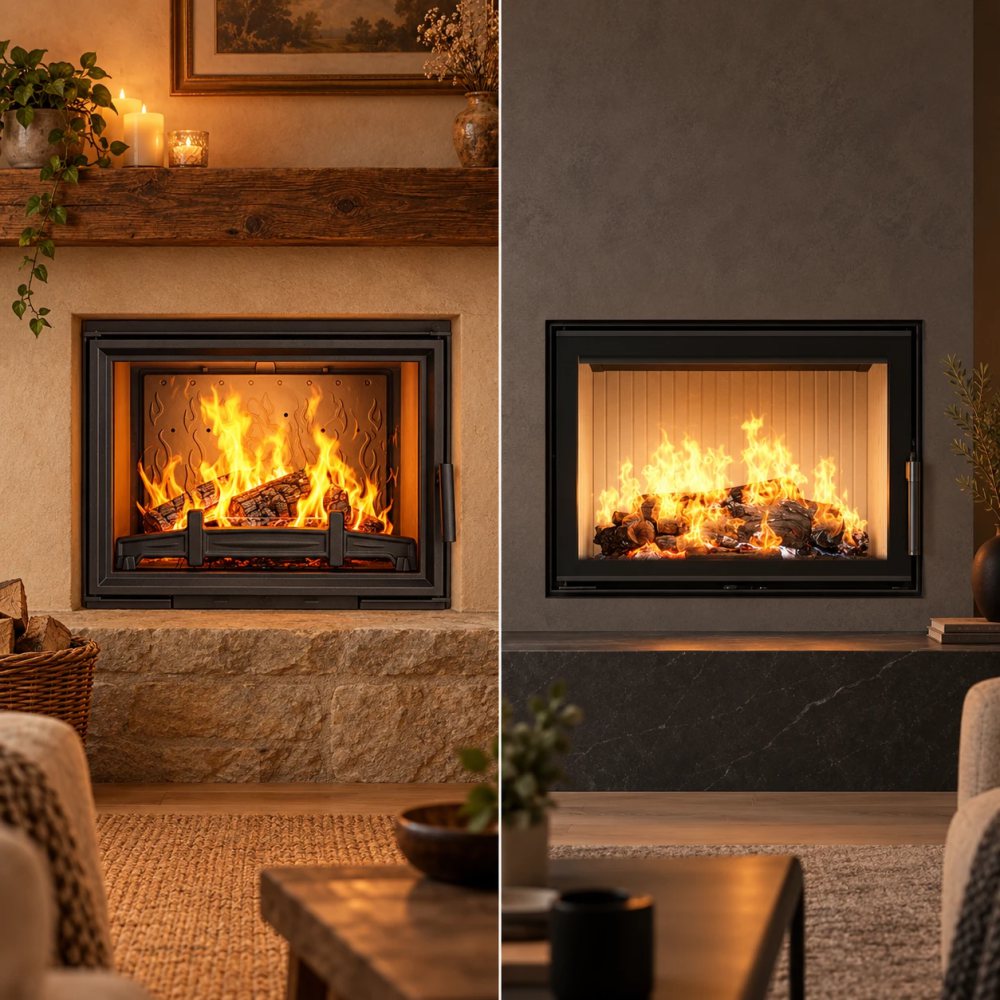
In short
- A cast iron insert has a body cast from iron. It gives a classic, compact construction with thick walls. Cast iron is brittle, so it does not like sudden changes in temperature.
- A steel insert has a body welded from steel plate, and the combustion chamber is usually lined with chamotte (firebrick) or vermiculite. This makes it easier to build large fireboxes and wide or corner glass.
- Heat storage capacity depends on the weight of the appliance and its lining, not on the name of the material. A kilogram of cast iron and a kilogram of steel store practically the same amount of heat.
- Order of choice: output first, then dimensions and glass shape, material last.
How a cast iron insert differs from a steel one
Cast iron insert — a casting
The body of a cast iron insert is made in a foundry: molten metal is poured into moulds, and the parts are then assembled into a combustion chamber. Castings usually have thick walls, and the material is hard and resistant to high temperatures. Inside you will find a grate, an ash pan and often a baffle (deflector) — a plate above the fire that lengthens the path of the flue gases. In the cast iron KAWMET W17 (12.3 kW) ECO insert the baffle is made of vermiculite.
The limitation of cast iron comes from its nature: it is brittle. Large, sudden temperature changes can crack it, and after years the joints between parts may need resealing or tightening. That is why manuals for cast iron appliances stress a gentle first firing and gradual heating.
Steel insert — plate and lining
The body of a steel insert is welded from steel plate. Steel walls are thin, so manufacturers line the combustion chamber with chamotte or vermiculite panels. The lining protects the steel from direct flame, raises the temperature in the firebox and adds mass that stores heat. For example, in the steel SAVEN insert Energy 70x50 this is chamotte 35 mm thick.
Steel is ductile, so it is easier to build a large firebox, wide glass, a corner insert or an insert with a lift-up door (guillotine). The price is sensitivity to overheating: burning well above the nominal output can deform the plates over time, and the lining panels wear and need replacing from time to time.
“Cast iron stores heat, steel doesn’t” — how much of it is true
This is the most repeated sentence in buying guides and at the same time the biggest oversimplification. The amount of heat a material stores is described by its specific heat. For cast iron it is about 0.46 kJ/(kg·K), and for carbon steel about 0.49 kJ/(kg·K). In practice this means that a kilogram of cast iron and a kilogram of steel heated by 100 °C store almost the same energy — about 46 and 49 kJ respectively.
How long an insert keeps giving off heat after the fire dies down therefore depends mainly on:
- the weight of the whole appliance — the more heated material, the more stored heat;
- the combustion chamber lining — chamotte has a specific heat about twice that of metal;
- the fireplace surround — heat-storing materials in the surround can store more heat than the insert itself.
Cast iron inserts have thick walls, so their body tends to be massive. That does not mean a steel insert is always lighter. An example from our range: the cast iron chamber of the KAWMET W17 (12.3 kW) weighs 119 kg, while the steel SAVEN Energy 70x50 (15.1 kW) insert with chamotte lining weighs 194 kg. These appliances differ in output and size, so this does not make either of them “better”. It shows something else: instead of asking about the material, check the weight and type of lining on the product page.
Comparison: cast iron and steel in practice
| Criterion | Cast iron insert | Steel insert |
|---|---|---|
| Construction | Cast parts assembled into a combustion chamber | Welded steel plate, chamber lined with chamotte or vermiculite |
| Heat storage | Depends on the weight of the casting | Depends on the weight of the body and lining |
| Heating up | Needs gradual warming up | Also needs warming up, especially during the first firings |
| Typical risk | Cracks from sudden temperature changes or impact | Deformation from prolonged overheating, wear of lining panels |
| Glass and firebox shape | Mostly straight glass, compact firebox | Wide, corner and lift-up glass are easier to build |
| Wear parts | Gaskets, glass, grate, baffle | Gaskets, glass, lining panels, baffle |
The table describes typical design features. Details always depend on the specific model, so when comparing appliances, rely on their documentation.
Where to start: output, not material
The most common mistake when buying a fireplace is too much output. An oversized insert runs throttled, at too low a temperature. The glass blackens, soot and tar build up in the chimney and the wood burns inefficiently. This applies equally to cast iron and steel.
The starting point is the heat demand of the building. In new houses you will find it in the design documents as the design heat load. In older ones an energy audit or an installer’s assessment will help — taking into account insulation, windows, ventilation, volume and whether the heat is meant only for the living room or for other rooms as well. Quick kW-per-square-metre rules of thumb give only an order of magnitude. We write more about this in our guide how to choose the right fireplace insert output.
You will find the nominal output on the product page and in the technical documentation. It is also worth looking at the useful efficiency at nominal output and the energy efficiency class on the label. These values are measured according to the same rules for all appliances, so they can be compared fairly across brands.
Two examples from our range: cast iron KAWMET and steel SAVEN
Below we compare two inserts with straight glass, described by the same criteria. They are not a “better and worse” pair — they show how the constructions differ and what to look for on the product pages.
| Parameter | KAWMET W17 (12.3 kW) ECO | SAVEN Energy 70x50 (15.1 kW) ECO |
|---|---|---|
| Body material | cast iron | steel, 35 mm chamotte lining |
| Nominal output | 12.3 kW | 15.1 kW |
| Useful efficiency at nominal output | 71.3% | 78% |
| Energy efficiency class | A | A |
| Weight | 119 kg | 194 kg |
| Dimensions (W × H × D) | 600 × 492 × 455 mm | 762.5 × 1180 × 506 mm |
| Flue outlet diameter | 200 mm, top outlet | 180 mm, top outlet |
| Maximum log length | 500 mm | 600 mm |
| External air supply | yes | yes, from the back or bottom |
| Warranty | 5 years | 5 years |
KAWMET W17 (12.3 kW) ECO — cast iron in a compact form
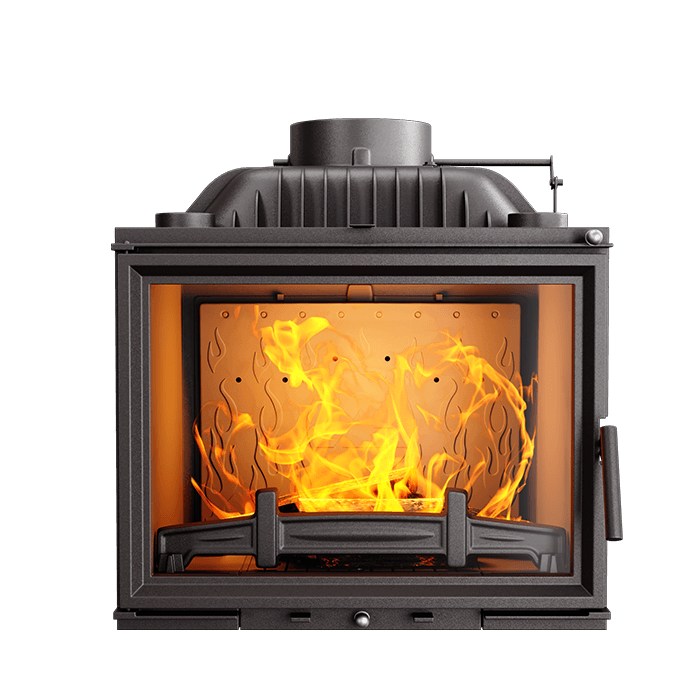
The KAWMET W17 (12.3 kW) ECO may suit people who want a classic cast iron insert with straight glass and a relatively small body — 600 mm wide with a weight of 119 kg. It has secondary combustion, an airwash (clean glass) system and a vermiculite baffle, and it is prepared for an external air supply, which matters in airtight houses with mechanical ventilation with heat recovery.
Keep in mind: 12.3 kW is a lot for a well-insulated house where the fireplace is mainly meant to heat the living room. The insert needs a 200 mm chimney. The parts for connecting the external air supply are ordered separately.
SAVEN Energy 70x50 (15.1 kW) ECO — steel and large glass
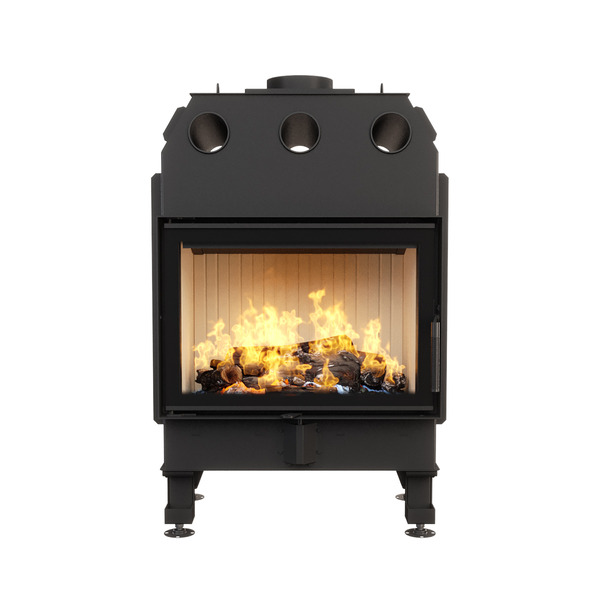
The SAVEN Energy 70x50 (15.1 kW) ECO is for people who want a large view of the fire — the glass measures 661 × 460 mm. The chamber is lined with chamotte, the insert takes logs up to 600 mm, and according to the product page it is designed for houses with mechanical ventilation with heat recovery. In its Ecodesign documentation the manufacturer states a seasonal efficiency of 68% and particulate emissions of 30 mg/m³ at 13% O₂.
Keep in mind: 15.1 kW is an output for a larger space that is actually being heated, or for a building with a higher heat demand. The appliance is 1180 mm tall and weighs 194 kg — the surround and the load-bearing capacity of the floor have to be planned in advance. The product page also gives the minimum areas of the inlet and outlet grilles in the surround: at least 755 and 1135 cm².
If you want large glass with a lower heat demand, see the SAVEN Balance series, which the manufacturer describes as inserts with wide glass and reduced output. Cast iron models with different outputs are in the cast iron fireplace inserts category.
When to choose cast iron and when steel
A cast iron insert may be a good choice if:
- you want a classic fireplace with straight glass and a compact firebox;
- you prefer a body without lining panels that need replacing over time;
- the space for the surround is limited and the chosen model fits with room for insulation and ventilation of the surround;
- you are ready to light the fire calmly, following the manual, without suddenly loading large amounts of wood into a cold insert.
A steel insert may be a good choice if:
- you want wide glass, a corner insert or a lift-up door — see corner inserts and inserts with a guillotine door;
- you are designing a modern surround with a large view of the fire;
- you accept that the lining panels are wear parts;
- you need longer logs or a larger combustion chamber.
Installation: what to check regardless of the material
- Chimney — diameter, height and draught must meet the requirements in the insert’s documentation. Before installation it is worth having the flue inspected by a chimney sweep.
- Floor load capacity — what counts is the weight of the insert together with the surround.
- Air supply — in a house with mechanical ventilation or airtight windows, an external air supply is usually essential for stable operation.
- Surround and grilles — the required distances from combustible materials, insulation and grille areas are given in the manual of the specific model.
- Professional installation — with a handover report. This also makes any warranty claim easier.
We have collected general installation and operation rules on the Installation and operation page. However, the manual of the chosen appliance and the building regulations in your country are always binding.
Ecodesign and local regulations
Since 1 January 2022 the European Union has applied the requirements of Commission Regulation (EU) 2015/1185 (Ecodesign) to solid fuel local space heaters. For closed-fronted appliances burning wood logs, seasonal space heating energy efficiency must be at least 65%, and particulate emissions must not exceed 40 mg/m³ at 13% O₂. The requirements are the same for cast iron and steel — the material gives no advantage here.
Meeting Ecodesign, however, applies to the appliance, not to the place where it is used. Many countries, regions and municipalities have their own rules on burning solid fuel — for example smoke control areas or regional air-quality regulations. Before you buy an insert, check the current regulations where you live. We explain how to read the Ecodesign declaration and other documents in the article Fireplace certificates, declarations and documentation.
Frequently asked questions
- Does a cast iron insert hold heat longer than a steel one?
Not because of the material itself. Cast iron and steel have very similar specific heat. An insert with a greater weight — including the combustion chamber lining — gives off heat for longer, as does a fireplace with a surround made of heat-storing materials. Compare the weight and construction of specific models.
- Does a steel insert warp?
It can if it is overheated for long periods, i.e. fired well above its nominal output. When used according to the manual with the correct wood load, the lining protects the steel plates from direct flame.
- Can a cast iron insert crack?
Cast iron is brittle and does not like sudden temperature changes. The risk increases with, among other things, very intense lighting of a cold insert, overheating, or hot glass or body coming into contact with cold water. That is why the first firings and everyday use should follow the manufacturer’s manual.
- Which insert is more environmentally friendly?
Emissions depend on the design of the combustion chamber, secondary combustion, the way you burn and the moisture content of the wood — not on the body material. Compare the values in the Ecodesign declarations of specific models and burn seasoned hardwood with a moisture content of up to 20%.
- Does a cast iron insert need chamotte?
Cast iron inserts usually do not have a full chamber lining, because the walls of the casting are thick enough. They may, however, have parts such as a vermiculite baffle. The product page of each model lists its equipment.
Summary
Choosing between cast iron and steel is above all a choice of construction, glass shape and the way you use the fireplace — not a choice between a good and a bad material. Start with output matched to the building, check the surround dimensions and chimney requirements, and only then compare cast iron and steel models in a similar output range.
Parameters, technical drawings and documents for each model are on the product pages: KAWMET cast iron inserts and SAVEN steel inserts. You can discuss the chosen model with a dealer in your country or send an enquiry from the product page.