
A fireplace in a house with heat recovery ventilation (MVHR)? Yes, the two can work together — and more and more people building new, airtight homes are doing exactly that. There is one condition you cannot skip: the fireplace must not compete with the ventilation for air. In practice this means an insert with a closed combustion chamber, a dedicated external air supply to the firebox and ventilation that does not create negative pressure in the house. If any of these is missing, the insert will smoke when lit, the glass will soil quickly and, in the worst case, flue gases may flow back into the room.
Below we explain where the problems come from, what building rules and manufacturers’ manuals say, how to plan the external air supply and what to look for on the product page when choosing an insert for a house with mechanical ventilation.
In short
- A fireplace and heat recovery ventilation can work together if the insert has a closed combustion chamber and takes combustion air through a duct from outside, not from the room.
- The most common problem is negative pressure. An airtight house has no “leaks” through which a fireplace used to get its air. When the ventilation or a cooker hood extracts more than it supplies, the chimney loses.
- An external air supply in a house with mechanical ventilation is treated by the KAWMET and SAVEN manuals as a necessity, not an extra.
- Match the output to the heat demand of the house. New, well-insulated houses usually need less heat than old rules of thumb suggest.
Why a fireplace and heat recovery ventilation can “clash”
In an older house with natural ventilation, air flows in through leaky windows, doors and vents. The fireplace takes the oxygen it needs from the room and nobody notices. A new house with MVHR is designed to be airtight — all air exchange runs through the ventilation unit, which supplies fresh air and extracts stale air in a controlled way.
While burning, a fireplace insert acts like an additional extract fan: it draws in combustion air and pushes flue gases up the chimney. The scale is not small. The former Polish building regulations required, for closed-fronted fireplaces, an air supply of at least 10 m³/h for every 1 kW of nominal output. For a 12.3 kW insert that is about 123 m³/h, and for 15.1 kW about 151 m³/h. If there is nowhere for this air to come from, the insert starts “sucking” it in through the chimney or the ventilation ducts.
Negative pressure can also appear even with well-designed ventilation:
- a cooker hood venting outside — the KAWMET manual explicitly names mechanical kitchen extraction as a typical cause of smoke when lighting;
- clogged supply filters — the unit supplies less than it extracts;
- a poorly balanced system, or supply switched off while extract is running.
The effects are smoke when opening the door, weak draught, sooty glass and, in extreme cases, flue gases — including carbon monoxide — flowing back into the room.
What building rules and manufacturers’ manuals say
Rules differ from country to country, so always check the ones that apply to your building with your designer. As an example, the former Polish building regulations (the 2002 technical conditions) required rooms with fireplaces to have a volume of at least 4 m³ per 1 kW of output and no less than 30 m³, the air supply of 10 m³/h per 1 kW mentioned above, and they banned mechanical extract ventilation in rooms with appliances that take combustion air from the room and have a natural-draught flue. The ban did not apply to balanced supply-and-extract ventilation or to positive-pressure ventilation — in other words, to a typical, properly balanced MVHR system.
Whatever the regulations, the appliance manual is binding. The manuals of both brands in our range say the same thing:
- KAWMET: if the building has mechanical ventilation, an additional fresh air supply to the fireplace must be provided — from outside or from an unheated basement. The cross-section of the air inlet should be at least 1/4 of the cross-section of the flue.
- SAVEN: an external air supply is always recommended and is mandatory with forced extract ventilation. If the house has forced extract, the supply must be equal to it or greater.
External air supply — how to plan it
The external air supply is a duct that brings air from outside directly into the combustion chamber of the insert. Thanks to it, the fireplace does not take air from the room or from the ventilation system. It is planned at the design stage or while the shell is being built — later it usually means breaking into the floor or walls.
Where to take the air from
Most often from outside, through an air intake in the wall or a duct under the floor. The KAWMET manual also allows an unheated basement. It is worth protecting the intake with a grille against leaves and rodents and placing it where snow will not block it.
Diameter and connection
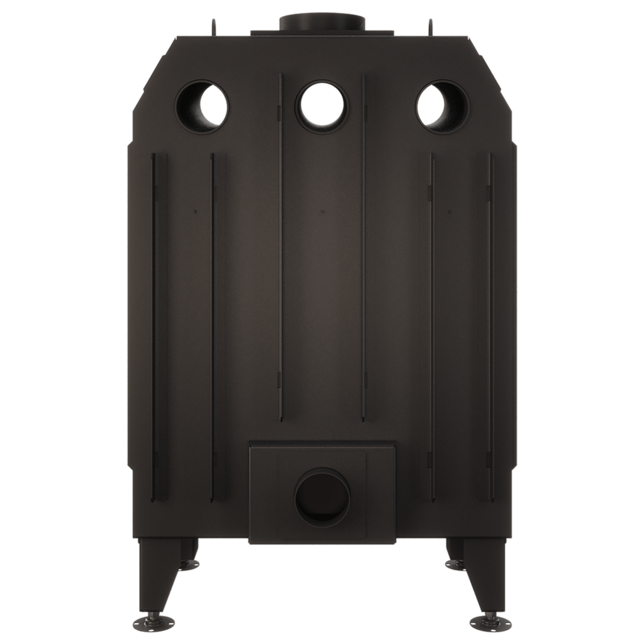
The diameter of the air supply is set by the insert manufacturer. In SAVEN steel inserts the duct cross-section must match the spigot on the body — for example, in the Energy 70x50 it is a 100 mm pipe, and in the Energy 80x50 a 125 mm pipe. All SAVEN inserts can be connected from the back or from below. The SAVEN manual recommends a tight connection made of non-combustible materials, such as a flexible aluminium pipe and a steel clamp. In KAWMET cast iron inserts the rule is at least 1/4 of the flue cross-section, and the parts for connecting the air supply are ordered separately.
What to watch out for
- Airtightness — any leak in the duct inside the surround means the insert will draw air from the convection chamber rather than from outside.
- Condensation — in winter, freezing air flows through the duct. The section running through the heated interior is worth insulating so that moisture does not collect on it.
- The simplest possible route — every bend and long section increases flow resistance. Discuss the length and number of bends with your installer.
- The option to close it — when the fireplace is not in use, an open duct means a constant flow of cold air into the surround. Ask your installer about a damper on the air supply.
Ventilation: what to remember besides the air supply
The air supply alone does not solve everything. A fireplace insert with a door is not completely sealed off from the room — when the door is opened and through gaps, some air may still reach the firebox from the room. That is why the way the whole ventilation system works also matters:
- Balanced MVHR — supply and extract should be set so that the house is not under negative pressure. Change the filters regularly.
- Cooker hood — a hood venting outside can reverse the chimney draught in seconds. Consider a recirculating hood or one with make-up air, and do not run a strong extract while lighting the fire.
- “Fireplace” mode on the unit — some MVHR units have a function that temporarily boosts supply when lighting. Check the documentation of your unit.
- Carbon monoxide detector — in a house with a fireplace it is a cheap and sensible safety measure.
It is best when the fireplace and the ventilation are designed together — the ventilation designer should know about the fireplace before choosing the unit and planning the ducts.
The surround: combustion air is not the same as convection air
Two independent air flows run through a fireplace. The first is combustion air — it reaches the firebox through the external air supply. The second is convection air — it enters through grilles in the lower part of the surround, warms up against the insert body and flows out through grilles at the top, heating the room. An external air supply does not replace the grilles. The minimum grille areas are given on the product page — for the SAVEN Energy 70x50 at least 755 cm² inlet and 1135 cm² outlet. Grilles matched to the inserts are in the SAVEN ventilation grilles category.
Which insert for a house with heat recovery ventilation
When choosing an insert for an airtight house with mechanical ventilation, check on the product page above all:
- whether the insert can be connected to an external air supply and from which side (back, bottom);
- the diameter of the air supply spigot — it determines the duct diameter;
- the nominal output compared with the actual heat demand of the house.
The last point is especially important. A house with MVHR is usually well insulated with a low heat demand. An oversized insert will run throttled, which means dirty glass and soot in the chimney. Before you choose a model, read our guide how to choose the right fireplace insert output.
| Parameter from the product page | KAWMET W17 (12.3 kW) ECO | SAVEN Energy 70x50 (15.1 kW) ECO | SAVEN Energy 80x50 (17.0 kW) ECO |
|---|---|---|---|
| Body material | cast iron | steel, chamotte lining | steel, chamotte lining |
| Nominal output | 12.3 kW | 15.1 kW | 17.0 kW |
| External air supply | yes | yes, from the back or bottom | yes, from the back or bottom |
| External air pipe diameter | — (manual rule: min. 1/4 of the flue cross-section) | 100 mm | 125 mm |
| Flue diameter | 200 mm | 180 mm | 200 mm |
| Suitable for houses with MVHR (per product page) | air supply recommended in houses with MVHR | yes | yes |
KAWMET W17 (12.3 kW) ECO — cast iron with external air supply
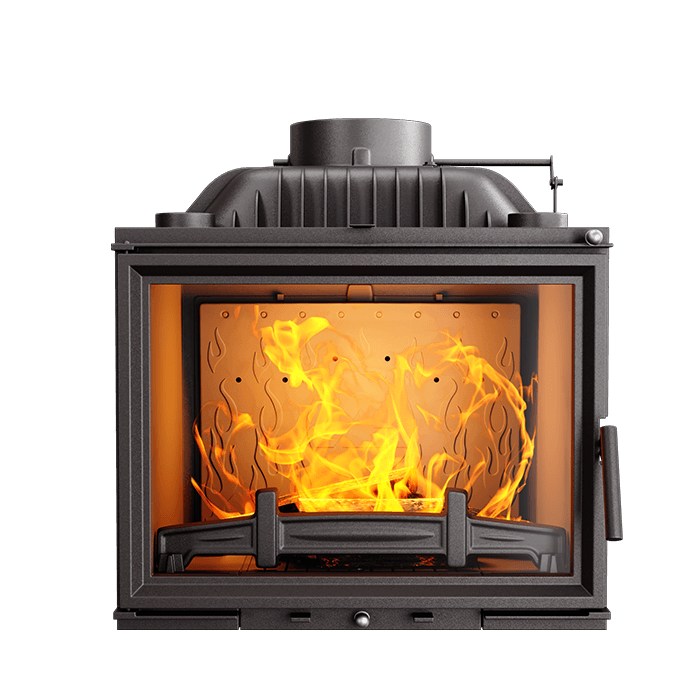
The KAWMET W17 (12.3 kW) ECO is a cast iron insert with straight glass, prepared for an external air supply. Its product page explicitly recommends this in an airtight building with mechanical ventilation or MVHR. It has secondary combustion and an airwash (clean glass) system. Keep in mind that 12.3 kW is a lot for a well-insulated house, and the parts for connecting the air supply are ordered separately.
SAVEN Energy 70x50 (15.1 kW) ECO — steel, large glass, Ø100 mm air supply
According to its product page, the SAVEN Energy 70x50 (15.1 kW) ECO is designed for houses with heat recovery ventilation. The air supply (100 mm pipe) can be connected from the back or from below, which makes it easier to run the duct under the floor or through a wall. The glass measures 661 × 460 mm and the chamber is lined with chamotte. This is an output for a larger space that is actually being heated — in a small, energy-efficient house it may be too much.
If you need a bigger firebox, see the SAVEN Energy 80x50 (17.0 kW) ECO with a 125 mm air supply. Other models are in the SAVEN steel inserts and KAWMET cast iron inserts categories. If you are deciding between cast iron and steel, read our article cast iron vs steel fireplace insert.
Checklist before installation
- The ventilation design takes the fireplace into account — the designer knows where it will stand and what output the insert will have.
- The applicable regulations are clear — you know which building rules your house is designed to.
- The air supply route is planned before the screed is laid: intake, duct route, insulation, a possible damper.
- The air supply diameter matches the manual of the chosen insert.
- The chimney has the diameter and height required by the manufacturer and has been inspected by a chimney sweep.
- Convection grilles have at least the area given on the product page.
- The cooker hood will not create negative pressure while the fireplace is burning.
- A carbon monoxide detector is fitted in the room with the fireplace.
General installation and operation rules are on the Installation and operation page.
Frequently asked questions
- Can you have a fireplace in a house with heat recovery ventilation?
Yes. You need an insert with a closed combustion chamber, a dedicated external air supply to the firebox and balanced ventilation that does not create negative pressure in the house. The fireplace and the ventilation are best designed together.
- Is an external air supply mandatory?
In a house with mechanical ventilation, the KAWMET and SAVEN manuals require an additional air supply to the fireplace — from outside or from an unheated basement. The SAVEN manual calls it mandatory with forced extract ventilation. In practice, in an airtight house it is a condition for the fireplace to work properly.
- What diameter should the fireplace air supply be?
The one given by the insert manufacturer. In SAVEN steel inserts the duct diameter must match the spigot on the body — e.g. 100 mm on the Energy 70x50 and 125 mm on the Energy 80x50. The KAWMET manual requires the inlet cross-section to be at least 1/4 of the flue cross-section.
- Why does the fireplace smoke when the cooker hood is on?
A hood venting outside removes a lot of air from the house and creates negative pressure. In an airtight house, air then starts coming in wherever resistance is lowest — including down the chimney. An external air supply, a recirculating hood or one with make-up air, and avoiding a strong extract while lighting the fire all help.
- Can a fireplace in a house with MVHR heat the whole house?
It can help with heating, but MVHR is not a system for distributing heat from a fireplace — it is for air exchange, not heating. Separate solutions are used to distribute heat. We write about how a fireplace can heat more rooms in the article can a cast iron fireplace heat an entire house.
Summary
A fireplace and heat recovery ventilation are a good combination if they are treated as one system from the start. An insert with a closed combustion chamber, an external air supply with the diameter required by the manual, balanced ventilation and a cooker hood that does not create negative pressure — these four elements decide whether the fireplace will heat without smoking.
Air supply parameters and other data are on the product pages: KAWMET cast iron inserts and SAVEN steel inserts. You can discuss the chosen model with a dealer in your country or send an enquiry from the product page.