
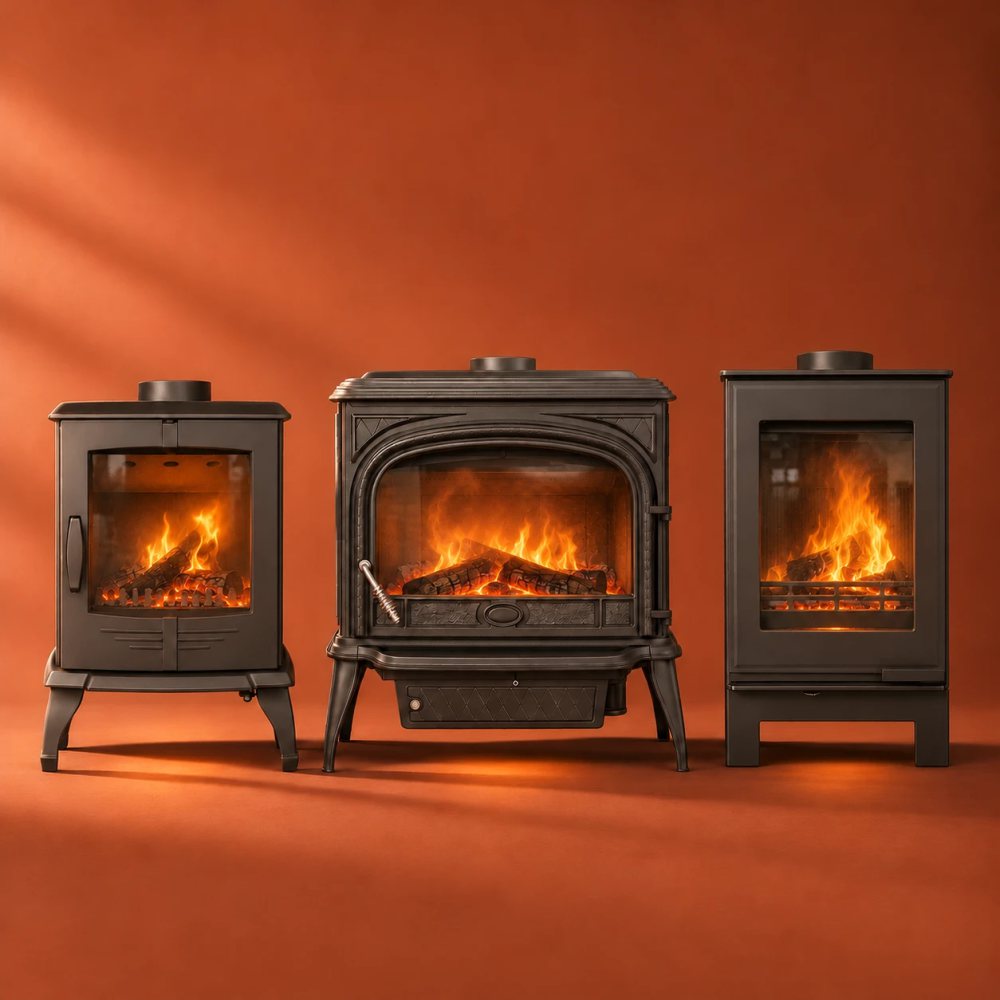
KAWMET's catalogue has 44 wood-burning freestanding stoves in three series: Standard ECO, Premium ECO and Modern ECO. Outputs range from 4.6 kW to 13.9 kW. Each series is built differently and suits a different interior. This guide explains how the series differ, what the model names mean and how to choose a stove in four steps. All figures come from the product pages in our catalogue.
In short
- Standard ECO (P3, P7, P8, P9, P10, P7 LB/PB, P7 CookTop): classic cast iron stoves, 6.8–10.5 kW. This series includes stoves with a panoramic glass and versions with a cooking plate.
- Premium ECO (from NIKA S5 to ARTEMIDA S18): cast iron stoves with decorative castings, 4.6–13.9 kW, all energy class A. Most of them can take combustion air from outside.
- Modern ECO (HARITA S15i, HARITA S15v, VENUS S16): modern modular stoves with a steel body and cast iron door. Efficiency above 80%, class A or A+, 24 configurations.
- All 44 models meet the Ecodesign requirements, according to their product pages.
- Outside air: all Modern ECO stoves and most Premium ECO stoves have it. Standard ECO stoves, PROMETEUS S11 and SELENA S14 do not.
The three series in one table
| Series | Models | Output | Efficiency / class | Body | Outside air |
|---|---|---|---|---|---|
| Standard ECO | 9 (P3–P10, P7 LB/PB, CookTop) | 6.8–10.5 kW | 65.9–78.1% / A or B | cast iron | no |
| Premium ECO | 11 (S5–S18) | 4.6–13.9 kW | 76–78% / A | cast iron | yes, except S11 and S14 |
| Modern ECO | 24 (HARITA S15i, S15v, VENUS S16) | 5.7–9.5 kW | 80.3–80.9% / A or A+ | steel + cast iron door and grate | yes |
Standard ECO: classic cast iron stoves
These are KAWMET's simplest and most traditional stoves. The whole combustion chamber is a single cast iron casting, and ribs on the side walls add heat-exchange surface. Cast iron warms up more slowly than steel, but keeps giving off heat long after the last load has burned out.
- P3 (7.4 kW) and P10 (6.8 kW): small stoves for a single room.
- P8 (7.9 kW) and P9 (8 kW): the highest efficiency in the series, about 78% and class A. P9 is narrow and tall (475 × 834 mm) and is the only one in the series with a Ø120 mm flue.
- P7 (9.3 kW): the most powerful of the basic models, logs up to 400 mm.
- P7 LB and P7 PB (10.5 kW): stoves with a panoramic glass, 775 mm wide, for logs up to 600 mm.
- P7 CookTop LB and P7 CookTop PB: the same 10.5 kW stoves with a plate for warming water or a pot.
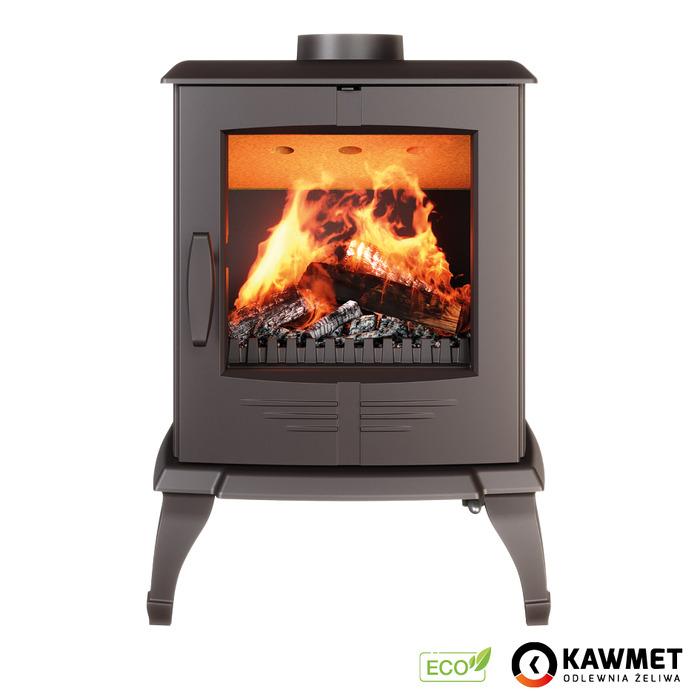
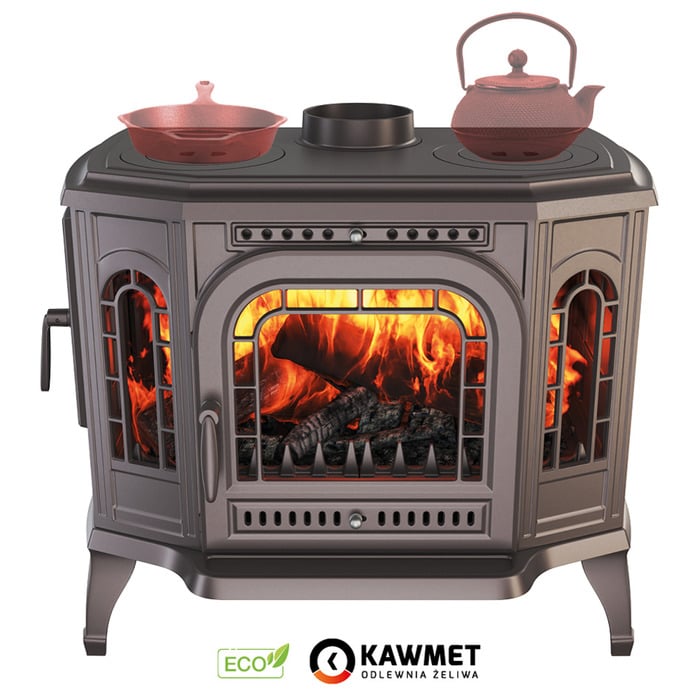
Pictured: KAWMET P8 (left) and KAWMET P7 CookTop LB (right).
What do LB and PB mean? They show which way the door opens: on LB versions it opens to the left, on PB versions to the right. Everything else is the same. Choose the version that will be easy to open where the stove will stand.
Keep in mind: no Standard ECO stove has a factory outside-air connection. They take combustion air from the room. In an airtight house, especially one with heat recovery ventilation, a Premium or Modern stove is the better choice.
Premium ECO: cast iron with character
Premium ECO stoves are fully cast iron, but with richer, decorative castings. Each one is named after a figure from Greek mythology. All are class A with 76–78% efficiency. Some models share the same body and firebox and differ only in the casting design:
- NIKA S5, ARES S7 and ZEUS S9: 11.3 kW, panoramic glass, logs up to 500 mm, Ø130 mm flue.
- SPHINX S6, HELIOS S8 and SPARTA S10: 13.9 kW, the most powerful KAWMET stoves, 180 kg of cast iron, Ø150 mm flue.
- ATHENA S12 (12.3 kW) and EOS S13 (10 kW): large stoves for an open-plan ground floor.
- PROMETEUS S11 (8.5 kW) and SELENA S14 (6.5 kW): mid-size stoves without an outside-air connection.
- ARTEMIDA S18 (6.5 kW) and HESTIA S17 (4.6 kW): small stoves with an outside-air connection, a good fit for an energy-efficient house. HESTIA has the lowest output in the whole KAWMET range and 78% efficiency.
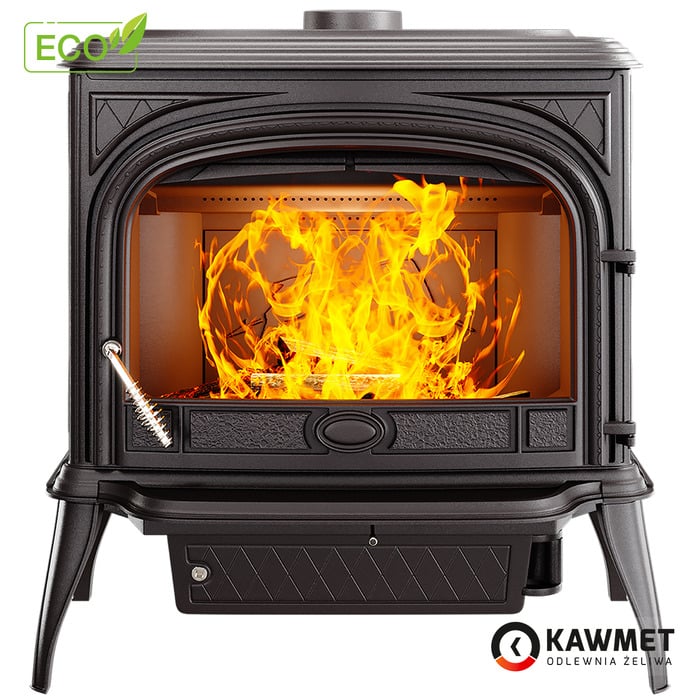
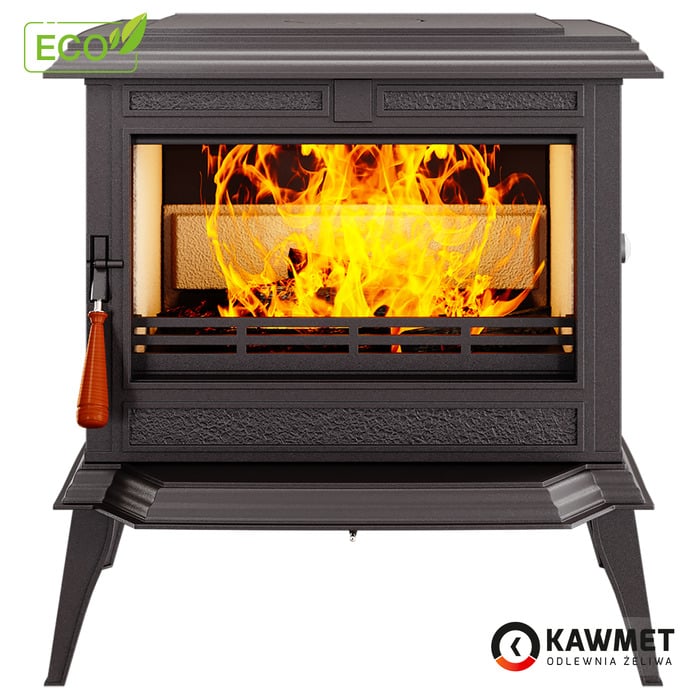
Pictured: KAWMET Premium NIKA S5 (left) and KAWMET Premium ATHENA S12 (right).
Premium product pages list the flue as "Ø130 (125/139)" or Ø150 mm. With Ø130 mm, check with your chimney sweep which connecting pipe suits your chimney.
Modern ECO: HARITA and VENUS modular stoves
Modern ECO is KAWMET's newest series. The body is steel, while the door, grate and flame baffle (the parts under the most heat) are cast iron. A stove built this way warms up faster than a fully cast iron one. All models have over 80% efficiency, a Ø150 mm flue and an outside-air connection. The footprint is always the same: 423 × 385 mm.
You choose the stove in three steps:
- Body. HARITA S15v: 5.7 kW, vermiculite-lined firebox, class A+. HARITA S15i: 6.5 kW, cast iron-lined firebox, class A. VENUS S16: 9.5 kW, cast iron sides and vermiculite back, class A+, logs up to 380 mm. The letter in the HARITA name stands for the lining: i for iron, v for vermiculite.
- Glass. Classic, or Decor with a tinted border. The glass changes only the look, not the performance.
- Base. Basic is a low unit (710 mm for HARITA, 810 mm for VENUS). Leg is a slim pedestal, and S-Box and L-Box are bases with a log store, smaller and larger. With a taller base the stove is about 1–1.2 m high.
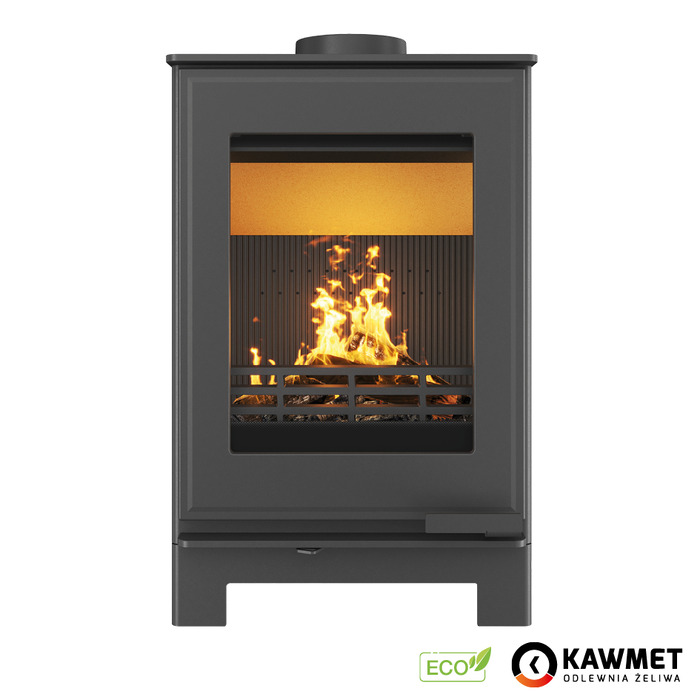
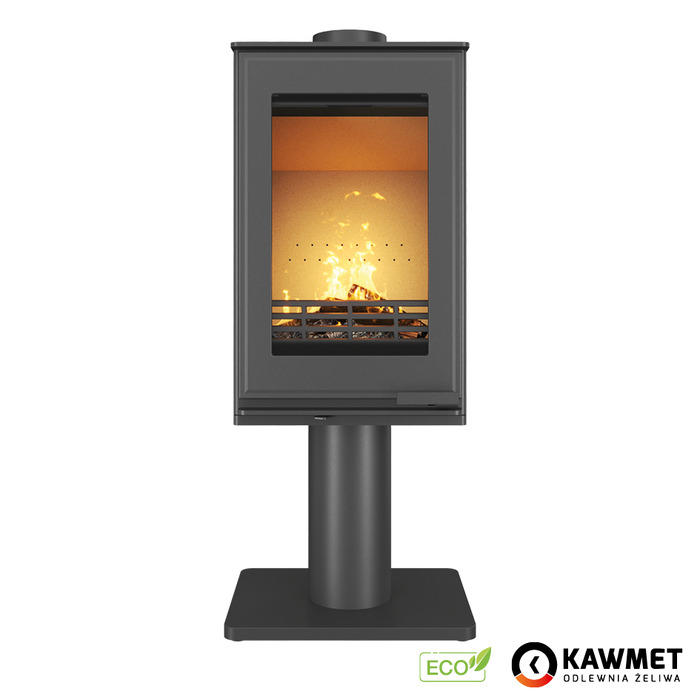
Pictured: KAWMET HARITA S15i Basic (left) and KAWMET VENUS S16 Leg (right).
3 bodies × 2 glass types × 4 bases give 24 ready-made models. We describe the whole system in the article modular KAWMET HARITA S15 ECO and VENUS S16 ECO stoves.
How to choose a stove in four steps
1. Size it for the room, not the whole house
A freestanding stove gives off heat from its whole body straight into the room it stands in. That is why you size it for that room and the spaces open to it. KAWMET product pages give an approximate area: about 10 m² per kilowatt, for example 6.5 kW for up to 65 m². A well-insulated house needs less, an old uninsulated one needs more. An oversized stove runs with the air turned down, which dirties the glass and the chimney. We explain how to work out your heat demand in the guide how to choose the right power for your home.
2. Outside air in an airtight house
In a new, airtight house, and especially one with mechanical ventilation, the stove should draw combustion air through a duct from outside, not from the room. All Modern ECO stoves have this connection, as do all Premium ECO stoves except PROMETEUS S11 and SELENA S14. Read more in the article fireplace and heat recovery ventilation.
3. Chimney and flue diameter
Check what chimney you have and what pipe you can connect to it. KAWMET stoves have a Ø120 mm flue (P9 only), Ø130 mm (some Premium stoves) or Ø150 mm (all others). All of them can be connected at the top or the back. Always agree the connection with your chimney sweep.
4. Cast iron or steel: how long should it heat
Standard and Premium stoves are fully cast iron. They warm up more slowly but keep giving off heat long after the fire is out. Modern ECO stoves warm up faster because they have a steel body. If you light the stove every evening and want warmth until morning, cast iron is the better choice. If you light it now and then and want to warm the living room quickly, choose Modern ECO. We compare the two materials in the article can a cast iron fireplace heat an entire house.
Full specifications table
| Model | Output | Efficiency / class | W × H × D [mm] | Weight | Logs | Flue | Outside air |
|---|---|---|---|---|---|---|---|
| Standard ECO | |||||||
| P10 | 6.8 kW | 66.6% / B | 490 × 615 × 450 | 77 kg | 300 mm | Ø150 | no |
| P3 | 7.4 kW | 71.6% / A | 465 × 625 × 420 | 86 kg | 300 mm | Ø150 | no |
| P8 | 7.9 kW | 78.1% / A | 508 × 675 × 410 | 96 kg | 350 mm | Ø150 | no |
| P9 | 8 kW | 78.1% / A | 475 × 834 × 384 | 79 kg | 300 mm | Ø120 | no |
| P7 | 9.3 kW | 65.9% / B | 574 × 662 × 474 | 118 kg | 400 mm | Ø150 | no |
| P7 LB / PB, CookTop LB / PB | 10.5 kW | 73.5% / A | 775 × 670 × 505 | 148 kg | 600 mm | Ø150 | no |
| Premium ECO | |||||||
| HESTIA S17 | 4.6 kW | 78% / A | 454 × 550 × 400 | 81 kg | 350 mm | Ø130 | yes |
| SELENA S14 | 6.5 kW | 76% / A | 535 × 700 × 409 | 100 kg | 400 mm | Ø130 | no |
| ARTEMIDA S18 | 6.5 kW | 76% / A | 535 × 663 × 407 | 135 kg | 400 mm | Ø130 | yes |
| PROMETEUS S11 | 8.5 kW | 76% / A | 566 × 599 × 433 | 90 kg | 400 mm | Ø130 | no |
| EOS S13 | 10 kW | 77% / A | 660 × 741 × 459 | 160 kg | 500 mm | Ø130 | yes |
| NIKA S5, ARES S7, ZEUS S9 | 11.3 kW | 77% / A | 681 × 712 × 524 | 140 kg | 500 mm | Ø130 | yes |
| ATHENA S12 | 12.3 kW | 77% / A | 735 × 804 × 608 | 180 kg | 500 mm | Ø150 | yes |
| SPHINX S6, HELIOS S8, SPARTA S10 | 13.9 kW | 77% / A | 775 × 808 × 572 | 180 kg | 550 mm | Ø150 | yes |
| Modern ECO (height and weight of the Basic version) | |||||||
| HARITA S15v | 5.7 kW | 80.7% / A+ | 423 × 710 × 385 | 98 kg | 350 mm | Ø150 | yes |
| HARITA S15i | 6.5 kW | 80.3% / A | 423 × 710 × 385 | 110 kg | 350 mm | Ø150 | yes |
| VENUS S16 | 9.5 kW | 80.9% / A+ | 423 × 810 × 385 | 113 kg | 380 mm | Ø150 | yes |
Efficiency is thermal efficiency at nominal output, and the class is the energy efficiency class from the product page. Height is given without the flue pipe. For some models the product page also gives the height to the top flue outlet, for example P3: 625 (695) mm. Full dimensions are on the technical drawing on each product page. Warranty terms are on the guarantee page.
Frequently asked questions
- What is the difference between the KAWMET Standard, Premium and Modern stove series?
Standard ECO are simple cast iron stoves of 6.8–10.5 kW, including stoves with a panoramic glass and with a cooking plate. Premium ECO are cast iron stoves with decorative castings, 4.6–13.9 kW, all class A. Modern ECO are modern HARITA and VENUS modular stoves with a steel body and over 80% efficiency.
- Which KAWMET stove has the highest output?
The most powerful are SPHINX S6, HELIOS S8 and SPARTA S10 from the Premium ECO series, at 13.9 kW each. They share the same 180 kg body and differ only in the casting design.
- Which KAWMET stove suits a small, energy-efficient house?
The lowest output belongs to HESTIA S17: 4.6 kW, with an outside-air connection. HARITA S15v (5.7 kW, class A+) and HARITA S15i (6.5 kW) from the Modern ECO series also suit a small house.
- Which KAWMET stoves can be connected to outside air?
According to the product pages, all Modern ECO stoves and all Premium ECO stoves except PROMETEUS S11 and SELENA S14. Standard ECO stoves take air from the room.
- What is the difference between HARITA S15i and HARITA S15v?
The firebox lining. S15i has a cast iron-lined firebox, 6.5 kW and class A, and keeps giving off heat for longer. S15v has a vermiculite lining, 5.7 kW and class A+, and warms up faster. Both versions have the same dimensions.
- Do KAWMET stoves meet the Ecodesign requirements?
Yes. The product pages state Ecodesign compliance for all 44 KAWMET freestanding stoves.
- Which KAWMET stove has a cooking plate?
P7 CookTop LB and P7 CookTop PB from the Standard ECO series. They are 10.5 kW stoves with a panoramic glass, for logs up to 600 mm.
Summary
If you want a classic, sensibly priced cast iron stove or one with a cooking plate, start with Standard ECO. If you want cast iron with a decorative casting and an outside-air connection, choose Premium ECO. Modern ECO suits a modern interior and an airtight house best. First size the stove for the room, then check the chimney and the air supply, and choose the look last.
You will find all models in the freestanding stoves category. If you have not yet decided between a stove and an insert, read the article fireplace insert or freestanding stove. A dealer in your country can help you choose the right model.