
W15 and W16 are the two largest KAWMET insert series: three outputs, BLACK versions and two corner inserts — 13 models in total. In photos they look alike, in the catalogue they sit side by side, and the difference in the name is a single digit. In this guide we explain what the W15 and W16 have in common, how they really differ and how to choose the right version in three steps. All specifications come from the product pages in our catalogue.
In short
- Same body: at the same output, the W15 and W16 have identical dimensions, efficiency, firebox, flue outlet and grille areas.
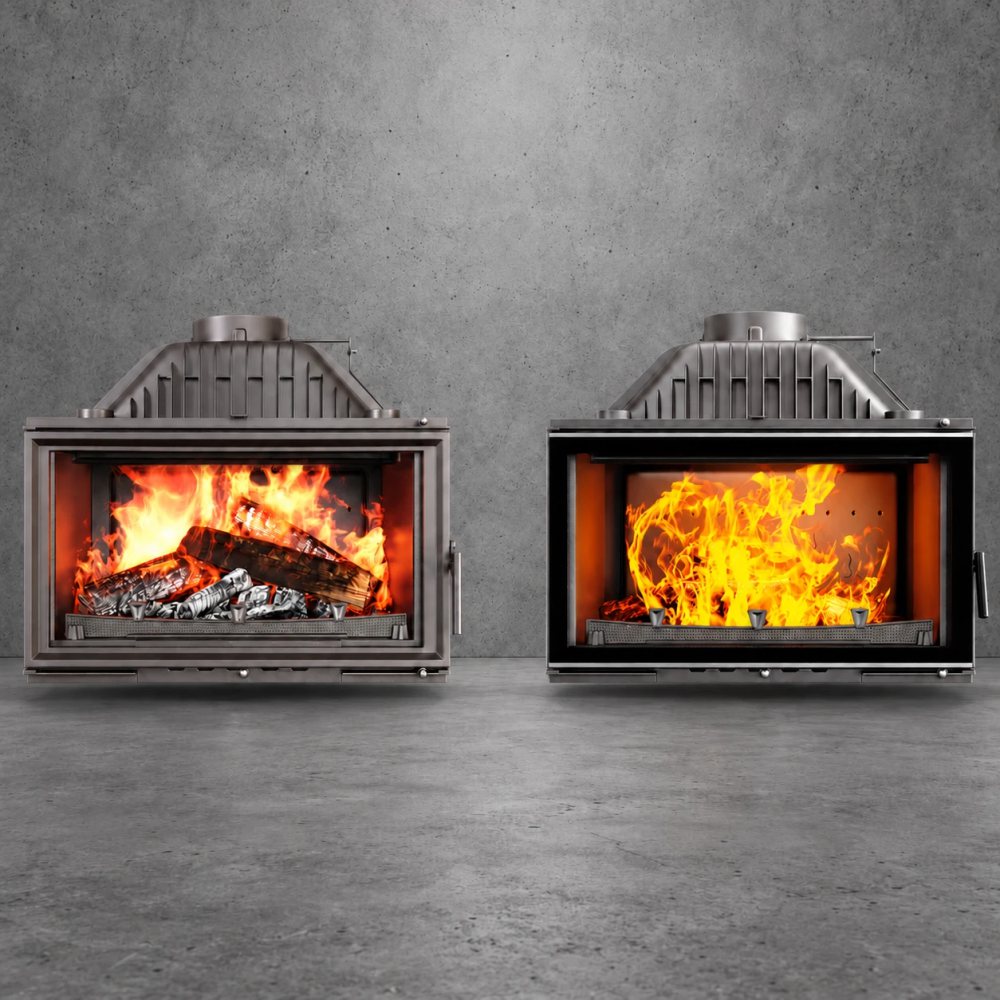
- Different door: the W15 has a classic cast iron door with a frame around the glass, the W16 has glass across almost the whole front — a bigger view of the fire.
- Three outputs: 9.4, 13.5 and 16.3 kW — in both series.
- Only the W16 comes in BLACK versions (a black trim strip instead of silver) and as the W16 LB and W16 PB corner inserts with an extra side glass.
- The 13.5 and 16.3 kW versions reach 80.4% efficiency and energy class A — the highest efficiency among KAWMET Standard ECO inserts.
What the W15 and W16 have in common
Both series are built on the same cast iron bodies. For a given output, the product pages list the same values:
- body dimensions — 620 × 365 × 370 mm (9.4 kW), 740 × 435 × 425 mm (13.5 kW) and 876 × 518 × 500 mm (16.3 kW);
- efficiency and class — 63.7% / B at 9.4 kW and 80.4% / A at 13.5 and 16.3 kW;
- maximum log length — 500, 600 and 700 mm;
- flue outlet — Ø180 mm at 9.4 and 13.5 kW, Ø200 mm at 16.3 kW;
- minimum inlet and outlet grille areas in the surround — the same for both series.
The equipment is shared too: secondary combustion, a clean glass system, a vermiculite baffle, a damper, an ash pan, a replaceable back plate and a replaceable grate. The grate is in fact a common part — the catalogue lists it as the KAWMET W15 / W16 grate (13.5 kW), as well as in 9.4 kW and 16.3 kW versions. All versions can be connected to an external combustion air supply, and their doors open to the left (except the W16 PB — more on that below).
How they differ: the door and the glass
The whole difference between the W15 and the W16 is the door. The W15 has a classic door with a cast iron frame around the glass. The W16 has glass running almost the full width and height of the front, finished with a trim strip — so at the same output it shows more of the fire.
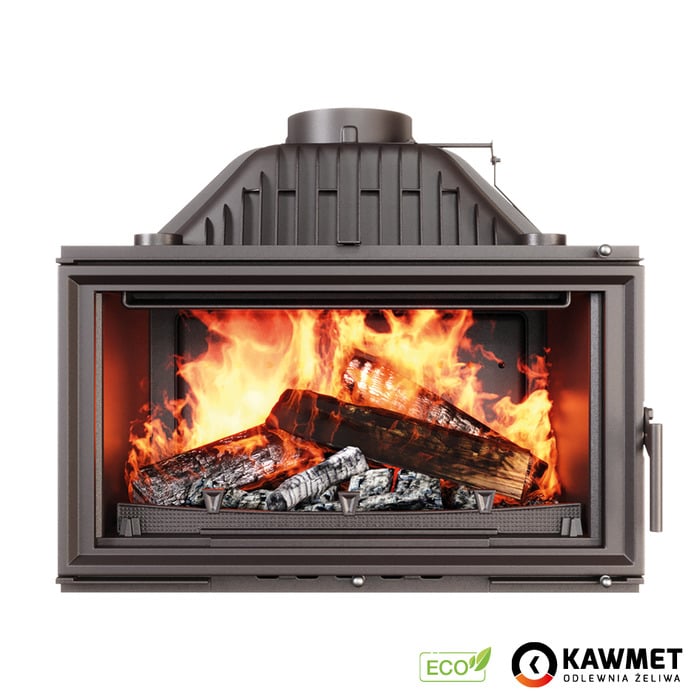
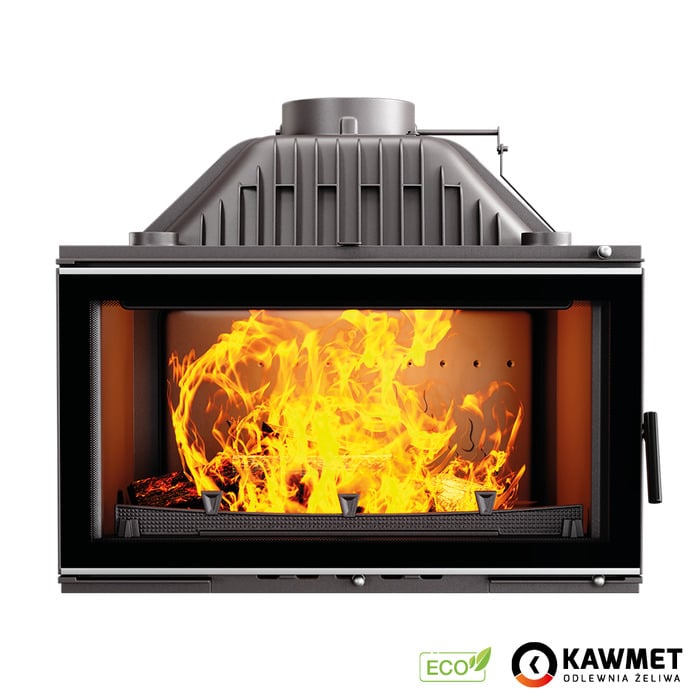
In the photos, the same 13.5 kW output: the W15 on the left and the W16 on the right. The main glass dimensions from the product pages show the difference clearly:
| Output | W15 glass (mm) | W16 glass (mm) | How much more glass in the W16 |
|---|---|---|---|
| 9.4 kW | 550 × 270 | 606 × 306 | approx. 25% |
| 13.5 kW | 670 × 330 | 722 × 370 | approx. 21% |
| 16.3 kW | 800 × 398 | 859 × 441 | approx. 19% |
The only other technical difference: at 16.3 kW the W16 is 7 kg heavier (202 kg versus 195 kg for the W15) — the weight of the larger glass door. At 9.4 and 13.5 kW both inserts weigh the same: 78 and 125 kg.
The three outputs of the W15 and W16
Output is the first thing to settle — only then do you choose the series. An oversized insert runs throttled, the glass blackens and soot builds up in the chimney. Output should match the building's heat demand, not just the floor area of the living room — more in the guide how to choose the right fireplace insert output.
9.4 kW — the smallest and lightest
The W15 (9.4 kW) and W16 (9.4 kW) are the smallest inserts in both series: a 620 × 365 × 370 mm body, 78 kg, logs up to 500 mm. The product page gives a heating capacity of up to 94 m². Efficiency is 63.7% and the energy class B — lower than in the larger versions, but still within Ecodesign requirements.
13.5 kW — the most popular size
The W15 (13.5 kW) and W16 (13.5 kW): a 740 × 435 × 425 mm body, 125 kg, logs up to 600 mm, 80.4% efficiency and class A. The W16 LB and W16 PB corner versions are also built on this size.
16.3 kW — for large spaces
The W15 (16.3 kW) and W16 (16.3 kW): an 876 × 518 × 500 mm body, 195–202 kg, logs up to 700 mm and a Ø200 mm flue outlet. A choice for large open-plan spaces and buildings with a higher heat demand. With this weight, the load-bearing capacity of the floor must be checked at the design stage.
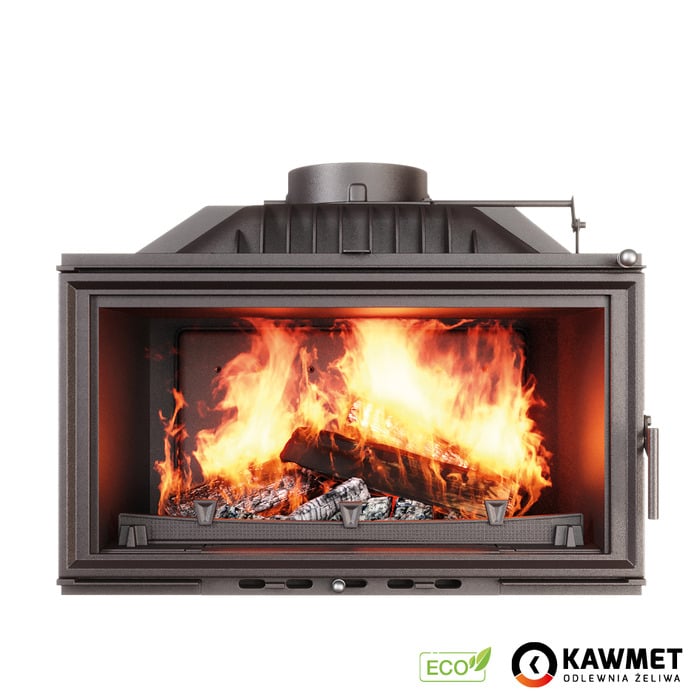
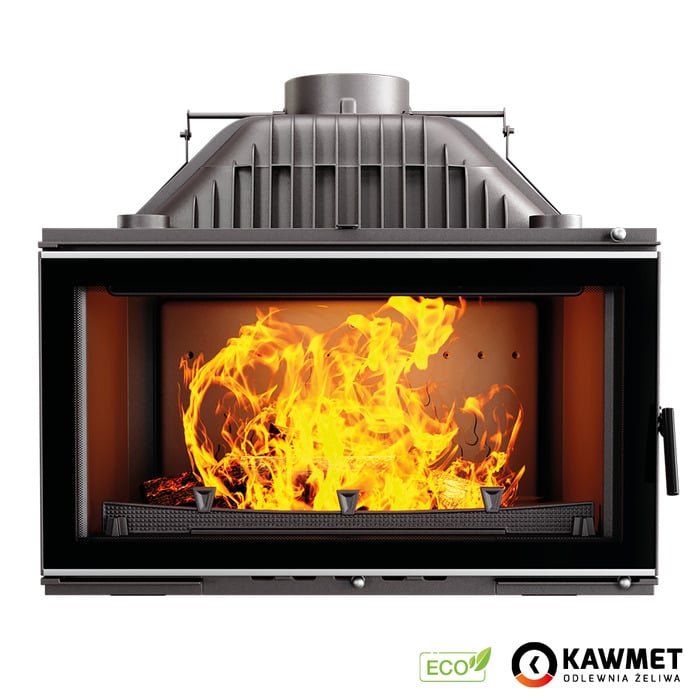
In the photos, the two extremes: the W15 (9.4 kW) and the W16 (16.3 kW).
W16 BLACK — a black trim strip
BLACK versions exist only in the W16 series, in all three outputs: W16 BLACK (9.4 kW), W16 BLACK (13.5 kW) and W16 BLACK (16.3 kW). According to the product pages, they differ from the standard W16 only in the colour of the trim strip on the front — black instead of silver. Dimensions, glass, efficiency and weight are the same. A good choice for dark surrounds and modern interiors where a silver accent would stand out too much.
W16 LB and W16 PB — corner inserts
If the fireplace is going into a corner, or you want to see the fire from two sides, choose a version with an extra side glass. The W16 LB has the side glass on the left, the W16 PB on the right. The side glass measures 408 × 405 mm and the front glass 760 × 405 mm. Both inserts have a 13.5 kW output, 80.4% efficiency and class A, an 805 × 447 × 453 mm body, 129 kg and logs up to 550 mm. The W16 LB door opens to the left, the W16 PB door to the right. Both are also available as BLACK: the W16 LB BLACK and the W16 PB BLACK.
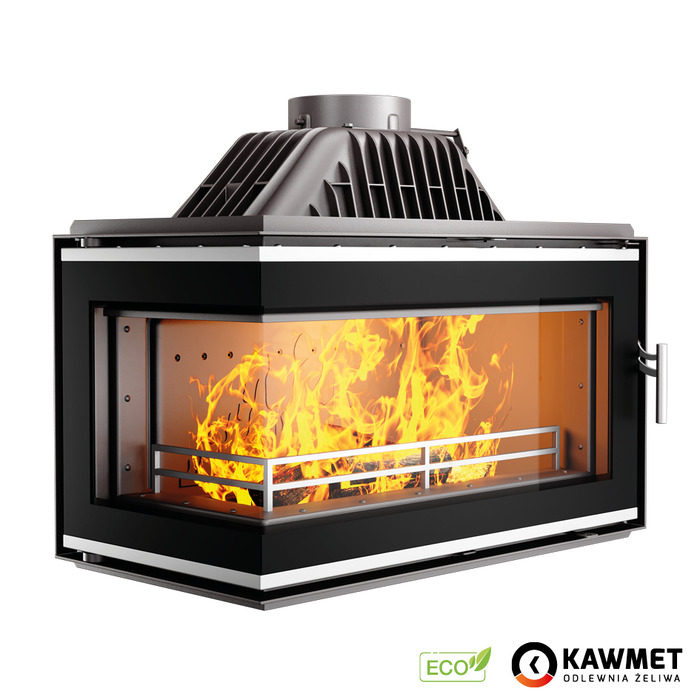
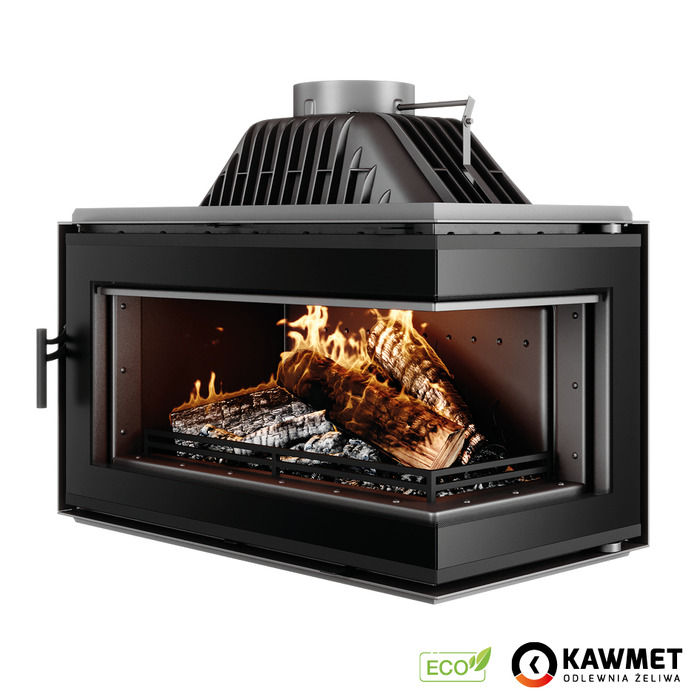
In the photos: the W16 LB (side glass on the left) and the W16 PB BLACK (side glass on the right). The standard W16 PB has a silver trim strip.
How to choose: three steps
- Output. Work out the heat demand and choose 9.4, 13.5 or 16.3 kW. Treat the heating capacity on the product page (94, 135 or 163 m²) as a reference for a house with standard insulation.
- View of the fire. A classic look with a cast iron frame — W15. Bigger glass on the same body — W16. A corner and fire visible from the side — W16 LB or W16 PB (13.5 kW only).
- Finish. A silver trim strip — the standard W16. Black — W16 BLACK, W16 LB BLACK or W16 PB BLACK.
Finally, check the technical drawing on the product page of the chosen model: surround dimensions with room for insulation and air circulation, the flue outlet diameter, the position of the external air supply (important in airtight homes — more in the article fireplace insert in a house with heat recovery ventilation) and the minimum grille areas in the surround.
All W15 and W16 models in one table
| Model | Output | Efficiency / class | Dimensions W × H × D (mm) | Weight | Glass (mm) | Logs up to | Flue outlet | Grilles inlet / outlet (cm²) |
|---|---|---|---|---|---|---|---|---|
| W15 | 9.4 kW | 63.7% / B | 620 × 365 × 370 | 78 kg | 550 × 270 | 500 mm | Ø180 | 470 / 705 |
| W16, W16 BLACK | 9.4 kW | 63.7% / B | 620 × 365 × 370 | 78 kg | 606 × 306 | 500 mm | Ø180 | 470 / 705 |
| W15 | 13.5 kW | 80.4% / A | 740 × 435 × 425 | 125 kg | 670 × 330 | 600 mm | Ø180 | 675 / 1013 |
| W16, W16 BLACK | 13.5 kW | 80.4% / A | 740 × 435 × 425 | 125 kg | 722 × 370 | 600 mm | Ø180 | 675 / 1013 |
| W16 LB, W16 PB (+ BLACK) | 13.5 kW | 80.4% / A | 805 × 447 × 453 | 129 kg | 760 × 405 + side 408 × 405 | 550 mm | Ø180 | 675 / 1013 |
| W15 | 16.3 kW | 80.4% / A | 876 × 518 × 500 | 195 kg | 800 × 398 | 700 mm | Ø200 | 815 / 1223 |
| W16, W16 BLACK | 16.3 kW | 80.4% / A | 876 × 518 × 500 | 202 kg | 859 × 441 | 700 mm | Ø200 | 815 / 1223 |
Efficiency is the thermal efficiency at nominal output, and the class is the energy efficiency class from the product page. Height is the body height; full installation dimensions are on the technical drawing on each product page. According to the product pages, all W15 and W16 inserts meet Ecodesign requirements. Warranty terms are described on the guarantee page.
Frequently asked questions
- What is the difference between the KAWMET W15 and W16?
The body is the same — at the same output they have the same dimensions, efficiency, firebox and flue outlet. The difference is the door: the W15 has a classic cast iron frame around the glass, the W16 has glass across almost the whole front. At 13.5 kW the W15 glass measures 670 × 330 mm and the W16 glass 722 × 370 mm.
- Do the W15 and W16 have the same output and efficiency?
Yes. Both series come in 9.4, 13.5 and 16.3 kW. The 9.4 kW versions have 63.7% efficiency and class B, the 13.5 and 16.3 kW versions 80.4% and class A.
- What is the difference between the W16 and the W16 BLACK?
According to the product pages, only the colour of the trim strip on the front: silver on the W16, black on the W16 BLACK. Output, dimensions, glass, efficiency and weight are the same.
- What do LB and PB mean in the KAWMET W16 name?
They are corner inserts with an extra side glass. The W16 LB has the side glass on the left and a door opening to the left, the W16 PB has the side glass on the right and a door opening to the right. Both have a 13.5 kW output.
- Do the W15 and W16 share parts?
Yes — at the same output both inserts use the same grate. The catalogue lists grates labelled KAWMET W15 / W16 in 9.4, 13.5 and 16.3 kW versions.
- Can the W15 and W16 be connected to an external air supply?
Yes. The product pages list an external combustion air supply option for all W15 and W16 versions, including the W16 LB and W16 PB corner inserts.
Summary
The W15 and W16 are the same cast iron insert in two styles. If you like a classic fireplace with a cast iron frame, choose the W15. If you want to see more fire, the W16 — and for a dark surround, the W16 BLACK. For a corner, there are the W16 LB and W16 PB. Match the output to the building and compare the technical drawings on the product pages before ordering.
All models are in the KAWMET Standard ECO inserts category. If you are still deciding between cast iron and steel, read the article cast iron vs steel fireplace insert. A dealer in your country can help you choose the right model.